Twins paradox in classical mechanics?
Vukota Babović · 2003
TWINS PARADOX IN
CLASSICAL MECHANICS?
Vukota Babović
R. Domanović 12, 34000 Kragujevac, S&M
Faculty of Sciences, Department of Physics
Abstract: The twins paradox, raised many years ago by Einstein himself, is considered by now as one of the greatest thought experiments ever invented. It helped much in testing logical consequences of the time dilation concept in the special theory of relativity. In this paper we have tried to elucidate an analogous (potentially realizable) classical experiment which could serve as a prolegomena for the twins story in modern physics introductory courses.
1. Introduction
The Twins Paradox in the special theory of relativity (STR) was formulated at one time with the aim to put on an additional logical test upon the strange consequences of the theory and eventually reveal controversies in the concept of time dilation. This in our days famous thought experiment has helped a more profound conceiving of the basic notions of relativistic mechanics. Modern introductory courses of physics [1] use the twins paradox as an excellent auxiliary pedagogical material in sections on special relativity. Shortly, this paradox can be traced as follows.
The two young twins (conveniently named in [2] as Speedo and Goslo) always carry with them identical, previously synchronized, clocks. Upon a certain day Speedo started an exciting special journey to a newly discovered planet in the vicinity of a star several lightyears from Earth. The brother Goslo saw him off at the space centre and stayed there for long staring in the going away rocket till it disappeared as a trifle on the blue sky. Nearly along the whole path Speedo’s spaceship moved with a relativistic speed of (say) one half of . Nevertheless, this journey has considerable prolonged. The impatient brother decided to go back immediately after the ship had safely landed on the target planet. He traveled towards Earth along the same trajectory and with the same speed as in the arrival. At last, Speedo returns and experiences the great surprise: he was noticeable younger than Goslo! In addition, the brothers compared their clocks and confirm this conclusion.
Of course, this story is astonishing in the frame of the pre-Eisteinian era. Besides, it is paradoxical in the very physics of relativistic speeds. The reason is the obvious violation of the principle of relativity (demanding no preferred inertial frame of reference). The formulation of the paradox permits that Goslo can regularly exclaim he were a moving object and therefore at last younger as compared with Speedo being all the time at rest according to this second variant of reasoning.
The physicists are (mostly) in agreement that the twins paradox, if elaborated in details correctly, is only an illusory contradiction. In principle, we resolve the puzzle by unmasking the covered up elements of story. The physical situations of Speedo and Goslo are not symmetrical and the brothers cannot exchange their positions. Speedo’s motion is not always without acceleration; he actually changes in return his inertial frame. The peculiarities hidden in the more or less laconic formulation of the Speedo’s adventure must be taken into account. “The conclusion that Speedo is in a noninertial frame is inescapable.” [3]
As far as we know, there is no thought experiment in classical mechanics which analogously try to ‘problematize’ the concept of Newtonian relativity, as the twins paradox does in the frame of Einsteinian relativity. Our attempt in this direction is derived as follow.
2. Sandglass… in rocket
This time the brothers wish to test the equivalence of their inertial systems and the very concept of classical (absolute) time even in cases of not exceedingly large velocities. Accordingly, Speedo uses now an old-fashioned type of rocket. Also, the twins measure time intervals with sandglasses; these clocks are identical and, of course, diligently synchronized. One day Speedo leaves Earth upwards, then travels a certain vertical path with constant velocity . After stopping, he comes back along the same trajectory, and with the same velocity. The meeting of two brothers was cordial. At the same time, they were fully astonished: the two masses of leaked-out sand were apparently different. Actually, the heap in Goslo’s sandglass was bigger! Of course, the amount of sand is the measure of passed time. Speedo’s conclusion was: “Something strange has happened, after the journey I am younger than my twin brother.”
A) Let us analyze, whether really is so. At first we shall check the above statement by means of a rough model of the physical situation. The rocket moves upward under constant acceleration which is supposed to be less of free-fall acceleration . Therefore, its velocity grows linearly to the value , achieved at the height . After this point the rocket continue to ascend but with the deceleration . It stops at the height and then immediately travels back toward Earth in the same fashion: the first half of the height with acceleration and the second with deceleration.
The whole mass of send in Goslo’s sandglass leaked out in the time interval from Speedo’s departure to his return can be expressed as
where is the proper constant of sandglass, i.e. the sand flux rate when no acceleration is present. As stressed in [4], vertical nonuniform motion of sandglass like structures changes the flux rate according to the local relation
Taking into account this result, the mass of the leaked out sand in Speedo’s sandglass (for the whole event of ascending and descending) is
We can find from Eqs.(1) and (3) the quotient of masses, i.e. conclude that according to the at-home clock the passed time is
where stands for going-away clock time. For weak accelerated rocket follows and if we have . In any case is . We see, Speedo is lucky with the equations of classical mechanics, too! He became younger that his twin at-home brother — in spite of rocket speeds much lesser that the speed of light. In fact, the difference is introduced via the acceleration. In order to stress the (only formal) resemblance with the STR formulae, we shall write
what follows from Eq. (4) in the approximation and with the abbreviation .
B) Let us now elaborate a more general model of motion including, as a particular case, the above journey. At the beginning the rocket moves in radial direction and increases its velocity till it reaches some maximal value . The acceleration is not necessary constant. The further ascend is with the constant velocity . After this portion of uniform motion, the rocket slowly loses its velocity and finally reaches the maximal height where . In return, the velocity profile is the same: first the accelerating portion, then the uniform part and finally the deceleration before landing.
So, instead of Eq. (4) we have
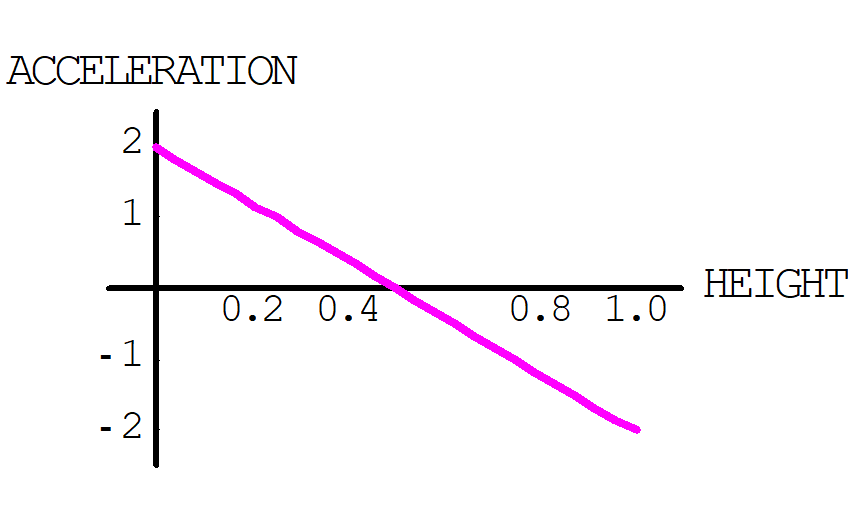
What can tell us this expression? Have we once again the message ? Analyze the next example. The velocity follows the sinus profile . (We have neglected the uniform portion which cannot affect the final result otherwise then quantitatively.) Now the acceleration is of the form . It means that the rocket is at the height in the moment . The () plot is the ellipse , see Fig 1a.

a)
b)
Fig. 1 a) Rocket velocity profile (abscissa: normalized height ; ordinate: normalized velocity ). b) Corresponding acceleration (abscissa: normalized height ; ordinate: normalized acceleration )
At the same time, the acceleration is the linear function of height, Fig 1b. Now, the expression (6) could be numerical treated, as we done in the program Mathematica. The result of computation is presented on Fig. 2. We see how the relative difference of time intervals, i.e. the percentage depends on the maximal velocity along the trajectory.
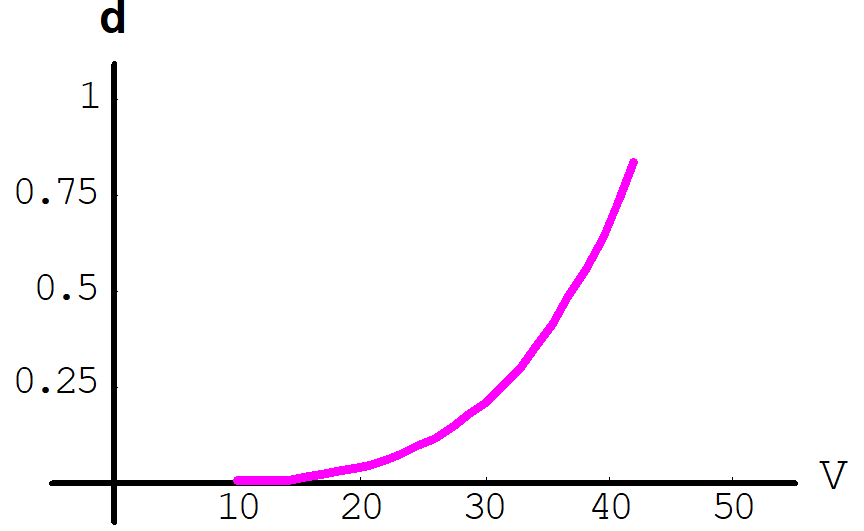
Fig. 2. Time difference versus maximal velocity diagram, for m; Goslo’s watch is always fast in comparison with Speedo’s watch, whatever the maximal velocity on the journey may be
The time interval shown by the at-home watch is always smaller then the ‘proper’ interval measured by the rocket watch. In a moving system of reference time passes slower. If we include (here neglected) the uniform motion in the central part of trajectory, it will reduce the difference in time intervals, but never would be .
3. Comments
We suppose the above story could be suitable as a relaxing prolegomena for the authentic Twins Paradox which is the respectable thought experiment in STR. This analogy, maybe only a witticism, nevertheless initiates some important topics:
A) Students encounter a set of physical notions which are more profound then it could seem in the realm of classical physics. The example of such kind is the synchronization of clocks, as well as the simultaneity of events. Further, the principle of relativity exceeds the limits of original Newtonian version; it demonstrates in modern physics a considerable heuristic potential.
B) In mentioned situations physicist cannot avoid the problem of reliable measurements of time intervals. A sandglass could serve as an obvious symbol of such a necessity. In any case we must be conscious how involved physical processes could affect the functioning of clocks. In sandglasses the rate of flow may be transparently understood.
C) As we see, most physics teachers point out the role of acceleration in the paradox. The twin-cosmonaut undergoes the acceleration in various phases of motion, which cannot be said for the twin at rest on Earth. The classical ‘version’ is convenient to support this discussion. The asymmetry of referential systems (in both versions) is directly connected to a rate of velocity change. This is also the starting point to discuss the meaning bifurcations in roles the acceleration plays and to stress true causes leading to the time relativity concept in STR. In both versions we can minimize the duration of accelerated and decelerated periods, but the very need of two twins to encounter and compare clocks is unavoidable.
REFERENCES
[1] Halliday, D and Resnick, R. (1988), Fundamentals of Physics, 3rd. ed. New York: John Wiley & Sons, New York
[2] Serway, R. A. (1998), Principles of Physics, 2^th^ ed. New York: Saunders, New York
[3] As above, p. 242
[4] Flores, J., Solovey, G. and Gil, S. (2003), Variable mass oscillator, American Journal of Physics, 71(7), 721-725.
[5] Flores, J., Solovey, G. and Gil, S. (2003), Flow of sand and a variable mass Atwood machine, American Journal of Physics, 71(7), 715-720.
BIO INFORMATION
Vukota Babović is Professor of Electromagnetism and Optics at the University of Kragujevac, Serbia and Montenegro. A graduate of the University of Belgrade, where he also obtained his doctorate, his research interests include the study of waves in plasma, microwaves and optics.